
If you’re a homeowner in Greater Vancouver or the Lower Mainland weighing your heat pump options, you’ve likely encountered the same fork in the road thousands of BC homeowners face every year: ductless mini-split or ducted central heat pump?
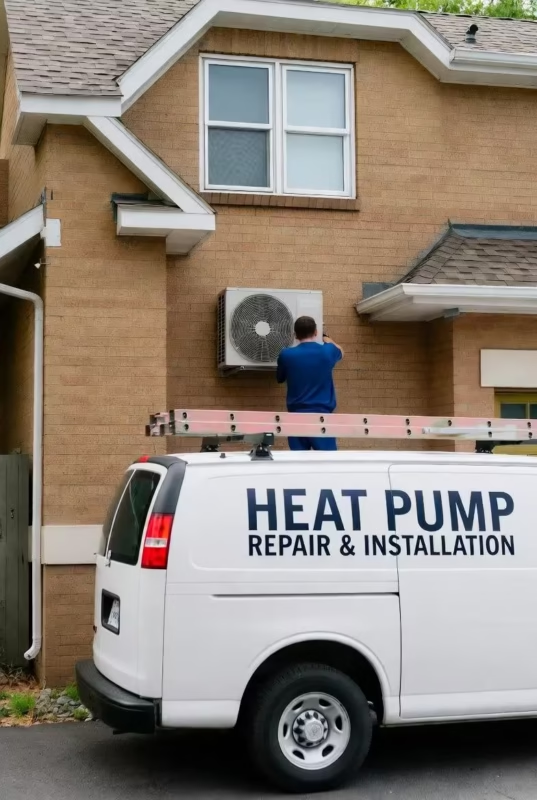
It’s not a trivial question. The system you choose will shape your comfort, your energy bills, and the value of your home for the next 15–20 years. And with the Province planning to deliver as many as 8,300 new heat pump rebates to British Columbians in fiscal years 2025-26 and 2026-271, the financial incentives for making the switch have never been stronger.
This comprehensive guide breaks down every meaningful difference between ductless and ducted heat pumps — from installation costs and energy efficiency to rebate eligibility and real-world performance in BC’s climate — so you can make a confident, informed decision.
Need personalized advice now? Our Red Seal Certified technicians can assess your home and recommend the right system during a free in-home estimate — no obligation, no pressure.
Table of Contents
- How Each System Works
- Ductless Mini-Split Heat Pumps: Pros & Cons
- Ducted (Central) Heat Pumps: Pros & Cons
- Cost Comparison: Ductless vs Ducted in BC (2026)
- Energy Efficiency & Operating Costs
- BC Rebates & Incentives for Both Systems (2026)
- Which System Is Best for Your Home?
- Climate Suitability: How Both Perform in Greater Vancouver
- Installation Process: What to Expect
- Frequently Asked Questions
- Next Steps: Get Your Free Quote
<a id=”how-each-system-works”></a>
How Each System Works
Before diving into pros and cons, let’s clarify exactly what we’re comparing.
Ductless Mini-Split Heat Pump
A ductless mini-split system consists of an outdoor compressor/condenser unit connected to one or more wall-mounted indoor air-handling units (called “heads”) via refrigerant lines. These systems have an external unit coupled to a head unit installed inside the house. The mini-split configuration is the cheapest installation and a more cost-effective system than the ducted system as it does not require installing ducts. Therefore, it’s great for retrofitting purposes as installation is a lot easier.2
Each indoor head serves a specific zone, and you can control temperatures independently in each room. A single-zone system has one outdoor unit and one indoor head. A multi-zone (multi-split) system connects multiple heads to a single outdoor unit.
Best for: Homes without existing ductwork, older homes, additions, condos, and homeowners who want room-by-room temperature control.
👉 Learn more about our ductless mini-split services.
Ducted (Central) Heat Pump
A ducted heat pump replaces or supplements your existing furnace and air conditioner. A ducted air-source heat pump warms your home by absorbing ambient heat in the outdoor air via a recirculating fluid and then transferring that heat to the indoor air, which is then cycled through your home’s duct system. This process is virtually the same as what occurs in your refrigerator. Even cold air has heat that can be extracted. These systems are comprised of two units: an outdoor unit to collect the heat, and an indoor unit to release it. They use the same ductwork as an air conditioning system and a furnace.3
It’s the more “invisible” option — all you see are the familiar floor or ceiling vents you already have.
Best for: Homes with existing ductwork in good condition, larger homes, and homeowners who prefer a hidden, whole-home system.
<a id=”ductless-pros-cons”></a>
Ductless Mini-Split Heat Pumps: Pros & Cons
✅ Pros
1. No Ductwork Required — Faster, Less Invasive Installation This is the single biggest advantage. If your Surrey rancher, Vancouver character home, or Burnaby condo doesn’t have ducts, a ductless system can be installed in as little as one day per zone with minimal disruption. There’s no need to rip open walls or ceilings.
2. Superior Zone Control Each head operates independently. Keep the bedroom cool at night while the living room stays warm — and don’t waste energy heating empty rooms. This allows room-by-room temperature control, reducing energy waste in unused spaces.4
3. Higher Energy Efficiency Ductless systems can be up to 60% more efficient than traditional systems since there’s no energy loss through ductwork.4 Typical forced-air duct systems lose 20–30% of conditioned air through leaks, gaps, and poorly insulated runs. Ductless systems eliminate this entirely.
4. Lower Upfront Cost (Single-Zone) For heating a single room or open living area, a single-zone mini-split is significantly more affordable than a full central system.
5. Dual Heating & Cooling Like all heat pumps, mini-splits provide heating in winter and air conditioning in summer — replacing two separate systems.
❌ Cons
1. Aesthetics — Indoor Units Are Visible Ductless HVAC systems aren’t as easy on the eye as the more disguised ducted ones and include units that need mounting within the rooms they’re heating or cooling.5 Wall-mounted heads are functional but visible. Not everyone loves the look.
2. Multi-Zone Costs Add Up Quickly If you live in a large family home with many rooms and multiple floors, the cost of installing a multi-split system with numerous indoor units and a couple of outdoor units could become prohibitive.5 A four- or five-zone ductless system can approach or exceed the cost of a ducted system.
3. Each Head Needs Maintenance Ductless systems require regular filter cleaning on each indoor unit.4 More zones means more filters to clean and more units to service.
4. Less Uniform Whole-Home Coverage In a large, multi-room home, a mini-split can create temperature disparities between zones and unserved areas (hallways, bathrooms, etc.).
<a id=”ducted-pros-cons”></a>
Ducted (Central) Heat Pumps: Pros & Cons
✅ Pros
1. Whole-Home Comfort From a Single System A ducted heat pump delivers conditioned air to every room through your existing duct network. It’s the true “set it and forget it” whole-home solution — even temperatures in every room, including hallways and bathrooms.
2. Clean, Invisible Aesthetics No wall-mounted heads, no exposed refrigerant lines. Just discreet vents in the floor or ceiling. For homeowners who value clean interior design, ducted systems win hands down.
3. Works With Your Existing Infrastructure If your home already has ductwork from a furnace or central AC, a ducted heat pump can often use it directly, simplifying installation. Good existing ductwork reduces installation costs significantly.6
4. Ideal for Larger Homes For homes over 2,000 sq. ft. with multiple bedrooms and floors, a single ducted system is generally more practical and cost-effective than installing 5–8 ductless heads.
5. Can Be Paired With a Furnace (Dual-Fuel/Hybrid) It is common for homeowners to install an air-source heat pump in tandem with a furnace, only relying on the furnace during especially cold periods.3 This dual-fuel setup maximizes efficiency and ensures comfort even on the coldest days.
Curious how a heat pump stacks up against keeping your furnace? Read our detailed guide: Heat Pump vs Furnace in BC: Which Is Better?
❌ Cons
1. Requires Existing Ductwork (or Expensive New Installation) If you want ducted heat but don’t already have ductwork, the average cost to install new ductwork is $40 to $65 per linear foot.6 For a typical home, that can add $5,000–$15,000+ to the project.
2. Duct Losses Reduce Efficiency Even well-sealed ductwork loses some energy. Older, leaky ducts can waste 20–30% of conditioned air before it ever reaches the room.
3. Higher Upfront Cost Ducted air-source heat pumps typically cost between $14,000 and $18,000 including installation.3 That’s before any potential ductwork repairs or modifications.
4. Less Granular Zone Control Traditional ducted systems heat the entire home to one temperature. While zoning dampers can be added, they increase cost and complexity.
<a id=”cost-comparison”></a>
Cost Comparison: Ductless vs Ducted Heat Pump in BC (2026)
Here’s what Greater Vancouver and Lower Mainland homeowners can expect to pay in 2026, before rebates:
| Cost Category | Ductless Mini-Split | Ducted (Central) Heat Pump |
|---|---|---|
| Single-zone system (installed) | $4,500 – $8,500 | N/A (whole-home only) |
| Multi-zone / whole-home (installed) | $9,500 – $25,000 | $14,000 – $18,000 |
| New ductwork (if needed) | Not required | $5,000 – $15,000+ |
| Ductwork repair/sealing | Not required | $1,000 – $5,000 |
| Electrical upgrades (if needed) | $1,000 – $2,000 | $1,000 – $2,000 |
| Annual operating cost | $170 – $1,200 | $600 – $1,800 |
| Typical lifespan | 15 – 20 years | 15 – 20 years |
Sources: Ductless mini-split systems run $6,000 – $12,000 on average while ducted air-source heat pumps cost $14,000 – $18,000 on average.3 Single-zone costs typically range from $4,500 to $6,500 for budget-friendly models while premium options can cost $6,500 to $8,500. Multi-zone setups range from $9,500 to $25,000, depending on the number of heads and outdoor units required.7
The Bottom Line on Cost
- Tightest budget + no ducts? A single-zone ductless mini-split is the most affordable entry point.
- Whole-home heating + existing ducts? A ducted heat pump is usually more cost-effective than installing 4+ ductless heads.
- Whole-home heating + NO ducts? It depends on your home’s layout. Often a multi-split ductless system is cheaper than ducted + new ductwork, but a multi-zone ductless system for a large home can approach the same price.
For a deeper dive into all heat pump pricing, check out our Heat Pump Installation Cost Guide for BC (2026).
<a id=”energy-efficiency”></a>
Energy Efficiency & Operating Costs
Both ductless and ducted heat pumps are dramatically more efficient than furnaces, boilers, or baseboard heaters. “Heat pumps provide year-round comfort with efficient cooling in the summer and heat in the winter, and they can be up to 300% more efficient than electric baseboard heating,” said Chris O’Riley, president and CEO, BC Hydro.1
But there are meaningful differences between the two:
Ductless Mini-Splits: The Efficiency Edge
- No duct losses: This is the key advantage. By delivering conditioned air directly into the room, ductless systems avoid the 20–30% energy loss that comes with ductwork.
- Inverter-driven compressors: Most modern mini-splits use variable-speed inverter technology, adjusting output to match demand rather than cycling on and off. This results in consistent temperatures and lower energy consumption.
- Zone-by-zone savings: Only heat or cool the rooms you’re actually using. You can run the heating or cooling units in individual rooms and turn off the units in the rooms you aren’t using. This method allows you to save about 30% off your energy bill compared to a ducted system.5
Ducted Heat Pumps: Still Highly Efficient
- Modern ducted heat pumps also feature variable-speed compressors and can achieve SEER2 ratings of 16–22+.
- Heat pumps can deliver 2–4 times more heating energy than the electricity they use, making them far more efficient than electric baseboards or many furnaces.8
- Efficiency depends heavily on duct condition. Sealed, insulated ducts can close the gap with ductless systems significantly.
What About Operating Costs in Greater Vancouver?
Households that switch from fossil fuels to electric heat pumps for space heating can see energy savings of as much as 80%.9 With BC Hydro’s relatively low electricity rates, both system types deliver excellent savings compared to natural gas furnaces, oil, propane, or electric baseboard heating.
If you’re currently using a gas furnace that’s 10+ years old, switching to either heat pump type can meaningfully reduce your monthly utility bills. Need emergency help with your existing furnace while you plan your upgrade? Our team provides 24/7 furnace repair across Greater Vancouver.
<a id=”rebates”></a>
BC Rebates & Incentives for Both Systems (2026)
This is where the decision gets really interesting. BC has some of the most generous heat pump rebate programs in Canada, and both ductless and ducted systems qualify.
CleanBC Energy Savings Program (Income-Qualified)
For a family of four making less than $87,350 annually, rebate amounts for a heat pump have been increased to $16,000 up from $9,500. Additional rebates are also now available for electrical-service upgrades, meaning some families could receive as much as $24,000 in rebates when switching to a heat pump.9
Based on your household income, the Energy Savings Program covers up to 100% of the cost of heat pump installation.10 That means some families pay nothing out of pocket.
BC Hydro Home Renovation Rebate Program
You could be eligible for up to $4,000 in rebates for replacing your current electric heating system with a heat pump.11 This applies to homeowners switching from electric baseboards or electric furnaces.
Condo & Apartment Rebates
Households in individual suites in multi-unit residential buildings could be eligible for up to $5,500 for a ductless mini-split heat pump.1 This newer program is a game-changer for condo owners in Vancouver, Burnaby, and New Westminster.
Key Rebate Requirements to Know
The BC government requires all rebate-eligible heat pumps to be installed by a member of the Home Performance Contractor Network (HPCN). If you hire a contractor who is not registered with the HPCN, or if you attempt a self-installation, you will be ineligible for any provincial rebates.12
Only systems with a variable-speed compressor are eligible; single-speed or two-stage systems do not qualify for most 2026 rebates.12
You must pre-register through the CleanBC participant portal and receive an Eligibility Code before work begins.12
💡 Blue Ridge Handles Your Rebate Paperwork
At Blue Ridge Heating & Cooling, we’re a Registered CleanBC Contractor and BC Hydro Contractor. We handle 100% of your rebate paperwork — from pre-registration to final submission — so you don’t leave a single dollar on the table. Contact us for a free quote and we’ll calculate your exact rebate eligibility.
Which System Is Best for YOUR Home?
There’s no universal “winner.” The right choice depends on your home, your budget, and your priorities. Here’s a practical decision framework:
Choose a Ductless Mini-Split If:
✔ Your home doesn’t have existing ductwork (older homes, homes with baseboard heaters, radiant heat, or boilers) ✔ You live in a condo or townhouse where ductwork installation isn’t feasible ✔ You want to heat/cool specific rooms rather than the entire house ✔ You’re on a tighter budget and a single- or dual-zone system meets your needs ✔ You’re adding climate control to a garage, suite, addition, or bonus room ✔ You want maximum energy efficiency and zone-by-zone control
Choose a Ducted (Central) Heat Pump If:
✔ Your home already has ductwork in good condition from an existing furnace or AC ✔ You have a larger home (2,000+ sq. ft.) with many rooms ✔ You prefer a clean, invisible look with no wall-mounted units ✔ You want even, whole-home heating and cooling from a single thermostat ✔ You plan to pair the heat pump with your existing furnace in a dual-fuel configuration ✔ Your home’s layout makes it impractical to install indoor heads in every room
Consider a Hybrid Approach
Many of our customers in Surrey, Langley, and Richmond opt for a combination: a ducted heat pump for the main living areas connected to existing ductwork, plus a ductless head in a basement suite, garage conversion, or upstairs bonus room. This gives you whole-home coverage with maximum flexibility.
Not sure which brand to choose? Our guide to the Best Heat Pump Brands for BC Climate (2026) breaks down the top options by performance, warranty, and value.
<a id=”climate”></a>
Climate Suitability: How Both Perform in Greater Vancouver
Here’s the good news: both ductless and ducted heat pumps perform exceptionally well in the Lower Mainland’s climate.
BC’s mild coastal climate and colder interior regions require different heat pump specifications. For Vancouver and the Lower Mainland, standard air-source heat pumps rated to -8°C work efficiently most of the year.13
Surrey, Vancouver, Burnaby, Richmond, and Langley rarely see temperatures below -5°C to -10°C for extended periods. This is the sweet spot for air-source heat pumps, where they operate at peak efficiency.
Cold climate heat pumps are so effective that in most climate zones in British Columbia, including the Lower Mainland and Vancouver Island, there’s typically no need to install a backup heating system.14
That said, for homeowners in higher-elevation areas like Maple Ridge, Coquitlam’s mountain neighborhoods, or communities further east like Abbotsford and Chilliwack, we recommend cold-climate rated models. Cold climate heat pumps are specially designed heating and cooling systems that can operate efficiently in temperatures as low as -25°C.14
Summer Cooling Matters Too
With Greater Vancouver experiencing increasingly warm summers, the cooling function of heat pumps has become just as important as heating. Both ductless and ducted systems provide full air conditioning — an essential upgrade from the days when Lower Mainland homeowners could “get by” without AC.
If you’re specifically looking at cooling options, check out our Air Conditioning Installation page for additional system comparisons.
<a id=”installation-process”></a>
Installation Process: What to Expect
Ductless Mini-Split Installation
- In-home assessment — Our technician evaluates your home, takes measurements, and recommends the optimal number of zones and head placement.
- Equipment selection — We match you with a rebate-eligible, properly sized system from leading brands.
- Installation (1–3 days) — Mounting indoor heads, placing the outdoor unit, running refrigerant lines (typically through a 3-inch hole in the wall), and electrical connections.
- Commissioning & testing — We verify refrigerant charge, airflow, and system performance in both heating and cooling modes.
- Rebate paperwork — We complete and submit everything on your behalf.
Ducted Heat Pump Installation
- In-home assessment — We inspect your existing ductwork, electrical panel, and overall home envelope.
- Duct evaluation — If you’re going to install a system that uses the existing ducting, you may have to allocate some funds to correct any leaks. The costs depend upon the condition of the ducting, so a budget between $1,000 and $5,000 should suffice.2
- Equipment selection & sizing — It’s important to select the correctly sized unit for your particular circumstances. A too-small unit will be overworked, while a too-large unit will be under-utilized.2
- Installation (1–3 days) — Removing old equipment, installing the outdoor and indoor units, connecting to ductwork, and electrical work.
- Commissioning, testing & rebate submission.
At Blue Ridge Heating & Cooling, every installation is performed by Red Seal Certified Journeyman Technicians who are Gas Fitter Class B Licensed and BC Safety Authority Registered. We carry full WorkSafeBC insurance and stand behind every job with our 100% satisfaction guarantee.
<a id=”faq”></a>
Frequently Asked Questions
Is a ductless heat pump cheaper than a ducted heat pump?
For a single-zone application, yes — ductless is significantly cheaper. For whole-home heating, it depends. Ductless mini-split systems cost $6,000 – $12,000 on average while ducted air-source heat pumps cost $14,000 – $18,000 on average.3 However, a 4–5 zone multi-split system can approach or exceed ducted pricing.
Can a ductless mini-split heat an entire house?
Yes, but it requires multiple indoor heads (a multi-split system). Homes over 1,200 sq. ft. must install a multi-split or central system11 to qualify for BC Hydro rebates. A multi-split with 3–5 heads can effectively heat a whole home, though hallways and smaller rooms between zones may rely on heat migration.
Do both systems qualify for CleanBC rebates?
Yes. Both ductless and ducted heat pumps are eligible for CleanBC and BC Hydro rebates, provided they meet efficiency requirements, appear on the approved product list, and are installed by an HPCN-registered contractor. The system must be sufficiently sized to serve as the primary heating source for at least 80% of the home’s conditioned space.12
How long does installation take?
Most residential ductless and ducted installations take 1–3 days. Complex multi-zone ductless systems or installations requiring new ductwork may take longer.
Which system is quieter?
Ductless mini-splits are generally quieter. Modern indoor heads operate at 19–26 dB — quieter than a whisper. Ducted systems rely on a blower fan and air moving through ducts, which produces more ambient noise, though modern variable-speed air handlers are much quieter than older models.
Can I switch from a furnace to a heat pump?
Absolutely. If you have existing ductwork, a ducted heat pump can replace your furnace and AC in one system. You can also keep your furnace as a backup in a dual-fuel configuration for the coldest days. Learn more: Heat Pump vs Furnace in BC.
What brands do you recommend for BC?
We install top-tier brands engineered for BC’s climate. For detailed comparisons, read our Best Heat Pump Brands in BC (2026) guide.
<a id=”next-steps”></a>
Ready to Choose? Here’s How to Get Started
Comparing ductless vs ducted heat pumps online can only take you so far. The best decision comes from a professional in-home assessment where a certified technician evaluates your specific home — your existing infrastructure, insulation levels, square footage, layout, and heating goals.
Why Homeowners Across Greater Vancouver Choose Blue Ridge Heating & Cooling
- ✅ 15+ years serving Surrey, Vancouver, Burnaby, Langley, Richmond, Coquitlam and all Lower Mainland communities
- ✅ Red Seal Certified Journeyman Technicians
- ✅ Registered CleanBC & BC Hydro Contractor — we maximize your rebates
- ✅ We handle 100% of rebate paperwork so you don’t miss a dollar
- ✅ Free in-home estimates with transparent, upfront pricing — no hidden fees
- ✅ 0% financing available to make your upgrade affordable
- ✅ 4.9/5 Google rating from 100+ verified reviews
- ✅ 100% satisfaction guarantee on every installation
- ✅ 24/7 emergency service with under 60-minute average response time
Whether you choose ductless, ducted, or a hybrid system, we’ll walk you through every step — from choosing the right equipment, to installation, to submitting your rebate paperwork.
📞 Call (604) 615-2212 or Request Your Free Quote Online
Already have a heat pump that needs service? Our team provides expert heat pump repair & maintenance across the entire Lower Mainland — available 24/7 for emergencies.